

Adding or updating deck railings can make your outdoor space feel like an extra room, but it also comes with serious safety responsibilities. Building codes treat deck railing as a critical guard system designed to prevent falls, especially from elevated decks where injuries can be severe. Even if your project feels “simple,” inspectors will look closely at railing height, spacing, and structural strength before signing off. Understanding the basics of these rules ahead of time helps you design a safer deck, avoid failed inspections, and choose materials that meet both aesthetic and legal standards. While this guide covers common code requirements, always confirm details with your local building department or a licensed professional before you build.
Why Deck Railing Codes Matter For Everyday Safety
Deck codes do more than create paperwork; they exist because falls from raised decks are a leading source of home injuries. Once a walking surface is more than about 30 inches above grade, most residential building codes require a guard system along open sides to reduce the risk of someone slipping or tripping over the edge. In code language, “guards” are the protective barriers at the edge of the deck, while “handrails” are the graspable rails along stairs and ramps, and both can be part of one deck railing system. The minimum standards for height, spacing, and strength are based on real-world testing and are designed to withstand adults leaning, children climbing, and everyday use over many years. When you treat these requirements as your baseline rather than suggestions, you get a deck that feels solid underfoot and gives your family and guests confidence. Deck railing codes also help protect you as a homeowner from liability. If an injury happens and your deck is found to be out of compliance, you may face insurance issues, denied claims, or legal headaches. A properly permitted and inspected deck, on the other hand, creates a clear record that you followed the rules in place at the time of construction. That is especially important if you plan to sell your home, because buyers, appraisers, and home inspectors often flag non-compliant railings. Thinking of the code as a minimum safety standard rather than an obstacle makes it easier to appreciate what each rule is trying to prevent.
Minimum Deck Railing Heights You Will Commonly See
In most areas of the United States that use the International Residential Code (IRC), any deck that is 30 inches or more above the ground must have a guard, and that guard must be at least 36 inches high, measured vertically from the walking surface to the top of the rail. Some jurisdictions, such as parts of California and Washington, go further and require 42-inch guards even on residential decks, so you can’t assume 36 inches is always enough. Local rules may also differentiate between single-family homes, multifamily buildings, and commercial spaces, with taller guard requirements in higher-traffic or public areas. Because the top rail might also serve as a stair handrail in some designs, you have to think about height consistently across the entire deck railing system. A quick call or visit to your local building office before you finalize plans can prevent costly rework later.
Guard Height Rules
On flat deck surfaces in typical residential settings, a 36-inch minimum guard height is often required, though some locations mandate 42 inches, especially for commercial or multifamily structures. The measurement is taken straight up from the finished deck surface to the very top of the rail, not the center or side.
Stair Handrail Heights
Along stairs, the graspable handrail portion is usually required to fall between 34 and 38 inches above the stair nosings, which may differ slightly from the guard height on the deck itself. When the top of the guard doubles as the handrail on an open stair side, it must still fit within this height range to be compliant.
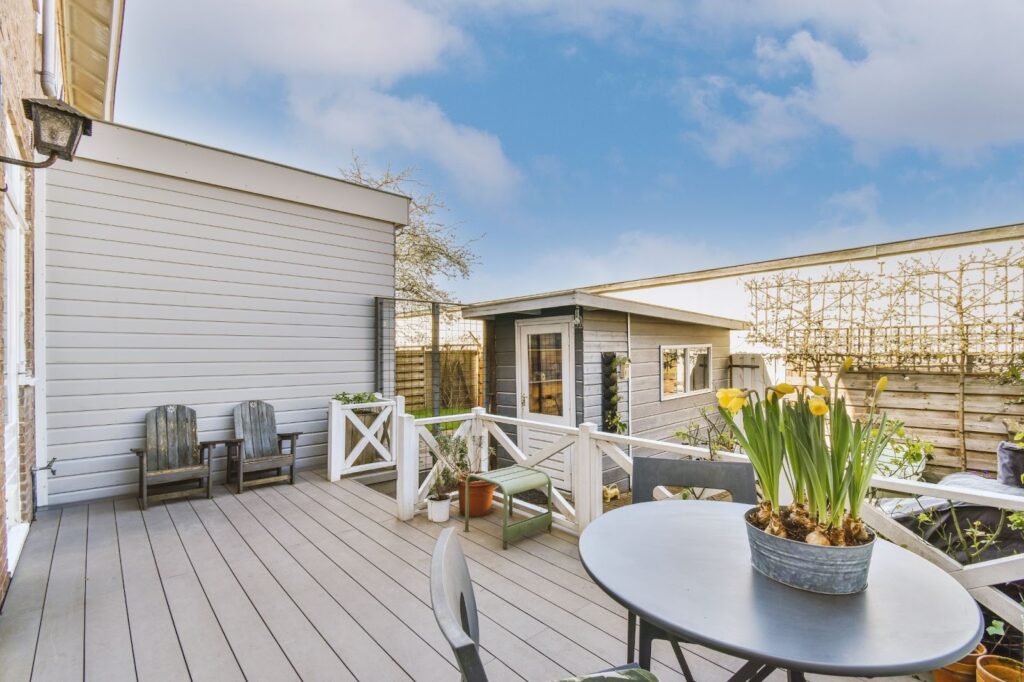
Deck Railing Opening Limits and Baluster Spacing To Protect Children
Height alone is not enough to keep people safe, especially children who may squeeze or climb through gaps. That is why most codes follow a “4-inch sphere rule,” which means no opening in the deck railing from the walking surface up to the required guard height can allow a sphere 4 inches in diameter to pass through. This rule applies to the spacing between balusters, the gap between a post and a baluster, and the space under the bottom rail above the deck surface. On stairs, there are specialized variations, but the idea is the same: openings must be small enough to prevent a child from slipping through or getting stuck. When you choose infill like vertical balusters, horizontal cable, or glass panels, you are really choosing how the openings in your deck railing are controlled. Vertical balusters are often spaced at around 4 inches on center so that the actual gaps remain under 4 inches after installation. Cable railing systems require tighter spacing and careful tensioning because cables can deflect when pushed, and inspectors will check that the 4-inch sphere rule still holds under reasonable pressure. For stair stringers, the triangular opening created by the tread, riser, and bottom rail usually has a slightly larger allowance, often capped so that a 6-inch sphere cannot pass through; this, too, should be confirmed locally.
Structural Strength Expectations For Modern Deck Railing Systems
Even if your deck railing meets height and spacing rules, it still has to be strong enough to resist common forces in everyday use. Codes based on the IRC and IBC typically require that guards and railings withstand a concentrated 200-pound load applied at any point along the top rail, as well as a uniform load per linear foot. That means a grown adult should be able to lean, stumble, or brace themselves on the rail without causing it to loosen or fail. This strength requirement affects everything from the diameter and spacing of posts to the size and placement of bolts, brackets, and blocking. Using only nails or light-duty screws into weak framing is rarely enough to meet code-level strength.
Top Rail Load Capacity
The top rail must resist a strong lateral push without excessive deflection, so connectors and framing beneath the surface must be engineered for that 200-pound test load. Pre-engineered railing systems and manufacturer-approved brackets make it easier to meet this standard.
Post and Fastener Details
Posts usually need to be anchored directly into rim joists or framing with through-bolts, blocking, and tension ties instead of surface-only fasteners. Inspectors will look closely at these connection points because they are the most common failure zones in poorly built railings.
Deck Railing Requirements For Stairs, Landings, and Changes In Level
Anywhere your deck design includes stairs, landings, or sudden changes in level, additional rules come into play. Guards are generally required on open sides of stairs and landings where the drop to grade exceeds a certain threshold, often the same 30-inch rule used for the main deck. On stairs, the deck railing must serve both as a guard and a safe handhold, which means it must meet height, continuity, grip size, and projection limits. The handrail portion must be easy to grasp, unbroken over the full length of the stair run, and terminate safely into a post, wall, or return rather than ending abruptly. The details may feel fussy, but they are all designed around how people actually move up and down stairs. Handrails must sit within a narrow band above the nosings so people of different heights can use them comfortably. There also needs to be enough clearance between the rail and any adjacent wall, typically at least an inch and a half, so fingers are not pinched. Width and profile rules help ensure the handrail is truly graspable, which is critical if someone slips or trips. Making these stair-specific requirements part of your initial deck railing plan is far easier than retrofitting a continuous, properly sized handrail after the fact.

How Deck Railing Materials and Maintenance Affect Code Compliance
Building codes generally care more about performance than aesthetics, which is why a wide range of materials can be used for deck railing as long as they meet the structural and spacing rules. Traditional wood railings, modern composite or PVC systems, aluminum railings, cable rail, and glass infill panels can all be compliant when installed correctly and supported by proper engineering. Many manufacturers provide testing data and code-compliance reports showing their products meet or exceed the required height, load, and opening limits, and inspectors often rely on that documentation during approvals. Choosing a system that is specifically marketed as code compliant for your region will usually simplify both design and inspection. Over time, maintenance plays a significant role in whether an older deck railing is still safe. Wood posts that have rotted at the base, corroded fasteners, or loose balusters can render a once-compliant railing noncompliant with code-level safety standards, even if the original design met all the rules. Home inspectors and building officials may require repairs or replacement if they see excessive movement, missing components, or visible damage. Regularly checking your railing for flexing, rust, decay, and loose connections—and addressing problems promptly—helps keep your deck in compliance with the spirit of the code long after the initial inspection is over.
Planning, Permits, and Inspections For New Deck Railing Projects
Before you buy materials or start demolition, it is worth confirming whether your project requires a permit and, if so, what deck railing standards your local office enforces. Some municipalities follow the latest edition of the IRC closely, while others adopt modified rules or entirely different standards, especially for coastal, seismic, or high-wind regions. Permit drawings often need to show railing height, post spacing, connection details, and how the railing transitions at stairs and landings. Getting clarity on these expectations early lets you design around them instead of improvising on site. It also gives you a chance to ask whether pre-engineered railing packages or specific fastening systems are preferred, thereby streamlining approvals.
Visit our Saddleback Fence and Vinyl Products blog to learn more about deck railing code requirements.